
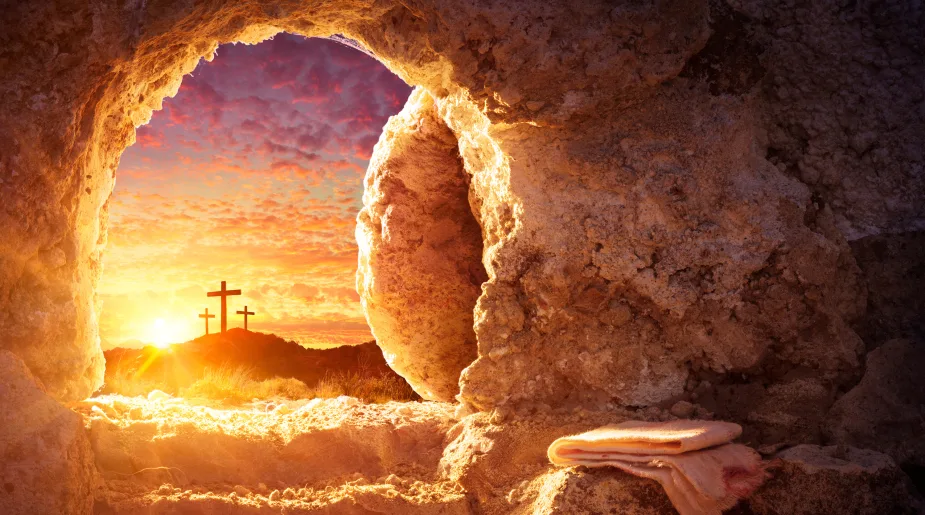

At the dawn of the Resurrection, we are not speaking about an ordinary event, but about a mystery that touches the very depth of existence. “He is truly risen” is not just a traditional phrase said at a certain time of year. It is a statement that divides history into two realities: one where human life is seen as bound to fate, and another where it is called to eternal life. In these words, the meaning of death changes, time is understood differently, and the relationship between God and humanity is redefined.
The Resurrection, at the heart of Catholic faith, is not simply the continuation of the Cross. It is its full completion. On the Cross, it seemed as if love had lost, evil had won, and silence had overcome every promise of God. Nevertheless, in the Resurrection, we understand that the silence was fullness, that sacrifice was not loss, and that death was not an end but a passage into fullness of life. Here we see God’s logic, which is not like human logic: strength is shown in giving, and victory is born from sacrifice.
This mystery cannot be understood apart from the unity of body and soul. The One who rose is not an idea or a memory, rather Christ himself, His body that suffered, His hands wounded by nails, his eyes that looked upon human weakness without condemnation. The Risen Body is not a return to the previous life, but a glorified state in which death no longer has power. This reveals the dignity of the human body in Christianity: the temple of the Holy Spirit became an eternal vessel, not a temporary vessel.
In the Resurrection, the promise of creation is fulfilled. Human beings were created in the image of God, and this image was not erased by sin, but wounded. The Resurrection is not only forgiveness. It is new creation. What was broken is renewed, what was divided is restored into unity. Because of this, the Resurrection is not limited to the individual. It extends to all creation, which waits to share in the freedom and glory of God’s children.
The Resurrection also has a historical dimension. It did not happen in isolation, but in a real place and time, with witnesses, within a context that could have either rejected or accepted it. The empty tomb is not a standalone proof; it is an open sign pointing to living encounters with the Risen Christ. Those who were afraid became witnesses, and those who were closed in on themselves went out into the world. This inner transformation is one of the deepest effects of the Resurrection, a movement from fear into mission.
In our time, where questions about meaning, identity, and destiny are everywhere, the Resurrection comes as an invitation. Modern people may have more tools and knowledge than ever before, yet still experience an inner emptiness that achievements cannot fill. The Resurrection enters this emptiness not to ignore it, but instead to open a greater horizon, where human beings are no longer limited to what they see, and are opened to what goes beyond understanding.
The moral power that comes from the Resurrection is not theoretical. Those who believe that Christ has risen are called to live from this reality. Forgiveness becomes possible where it once seemed impossible, hope is born in places of deep brokenness, and faithfulness continues despite disappointment. The Resurrection does not promise a life without suffering. It gives suffering meaning, making it bearable and even capable of becoming an act of love.
In Catholic liturgy, the Resurrection is not remembered as a distant event. It is made present. In the Eucharist, earthly time and divine time meet, and believers are invited to participate in this mystery, not as observers, but as participants. From this encounter, the Church is born, not only as a human structure, but as a living body that breathes from the Resurrection and is sent into the world as a sign of life.
The Resurrection also reveals the truth of freedom. God does not force belief, even in His greatest act. The Resurrection is announced, offered, and lived, yet never imposed. This is where its greatness resides: it respects human freedom even in rejection and waits for a free response. When this response is given, it is not only intellectual acceptance, but a transformation of life itself, where existence is reoriented toward eternity.
In the end, “He is truly risen” is not only about a past event. It is about a living reality. It says that life is stronger than death, that light cannot be overcome, and that love, no matter how weak it may appear at times, carries within it the seed of victory over death, the triumph over vice. Those who live this mystery do not escape the world; they enter it with new courage, seeing in every person the possibility of salvation and in every moment a new beginning. And so, the Resurrection does not remain an idea to think about. It becomes a life to live, a witness to give, and a light that passes from heart to heart, until the world, despite all its wounds, can truly say: He is Risen, and life is no longer the same.
Written by Patrick Riachi
Mariam 4 Apr 2026
“Christ is risen…
Death no longer has the final word,
and love has become the beginning that never ends.”
Allonline 5 Apr 2026
Amen