
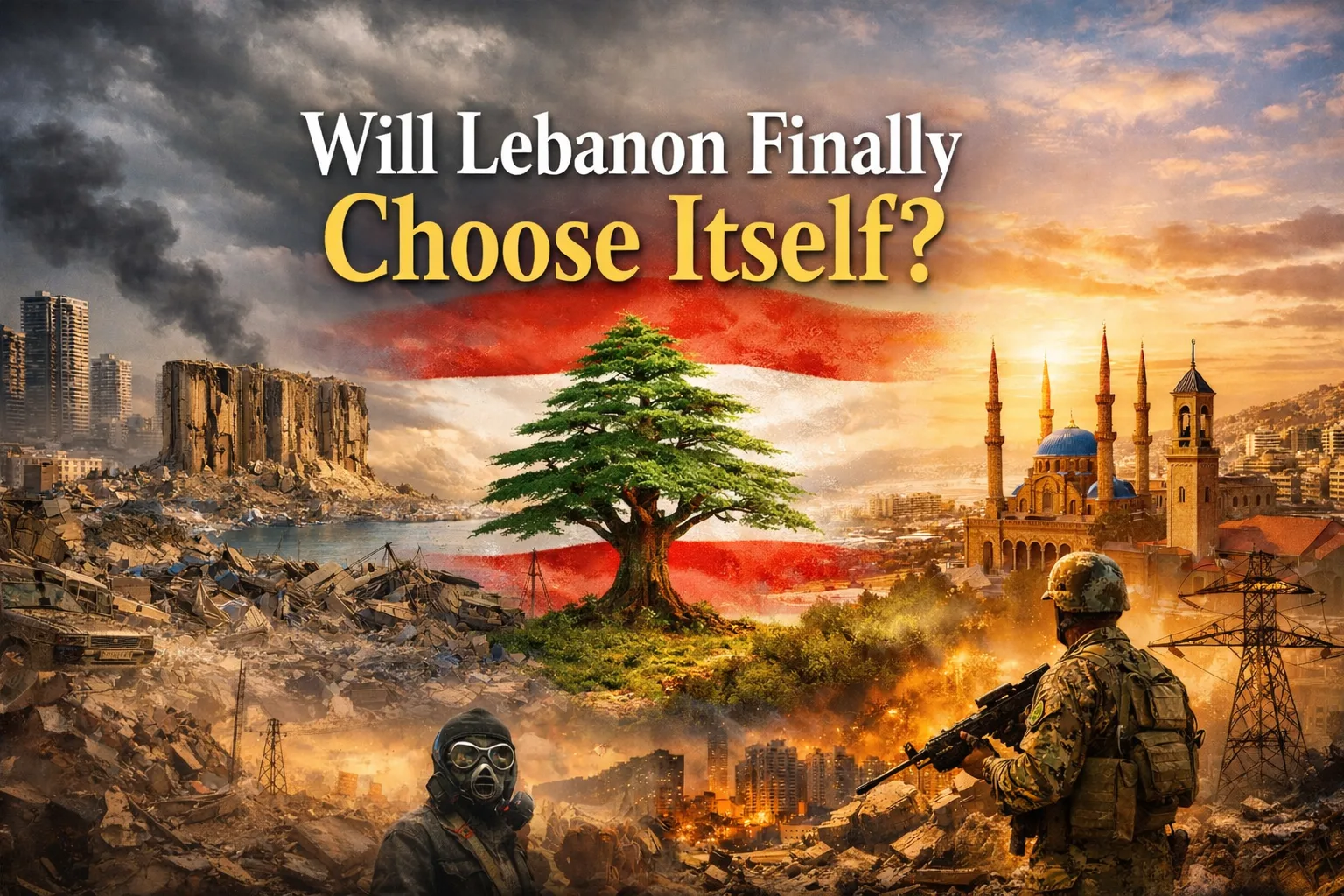

Will Lebanon Finally Choose Itself ?
When Narrative Replaces Sovereignty
An Opinion Piece
By Marie-Chantale Sundberg
April 7, 2026
Amid regional escalation and competing narratives, Lebanon confronts a deeper question:
whether sovereignty can survive without national consensus over war and peace.
My fingers itch to write again about Lebanon, politics, and a region that refuses to leave us in
peace, even when we attempt to leave it at the door.
Tonight, I am done remaining silent.
Over the past weeks, I have watched friends, relatives, analysts, self-proclaimed experts, and
aspiring journalists flood social media with certainty about the ongoing regional escalation.
Everyone seems convinced they possess the hidden truth, each camp rebuking the other with
theatrical confidence.
Between oddly entertaining propaganda videos, including the now-viral LEGO-style productions
circulating online, whose creativity I admire, and provocative messaging from political figures,
military spokespersons, ideological influencers, and evangelical activists abroad, public discourse
has become less a space for understanding and more a battlefield of competing narratives.
What began as mild annoyance turned into genuine alarm.
Not because opinions differ. Disagreement is inherently healthy. But reality itself has become
secondary to performance.
I am not writing as a professional political scientist, though I once studied political science. For
more than fifteen years, I deliberately distanced myself from television panels, talk shows, and the
relentless noise of daily news cycles. I remain informed, but on my own terms.
Experience has taught me to mistrust absolute narratives, especially those promoted by institutions claiming
monopoly over truth.
More often than not, reality lies between the opposing versions shouted at each other. Sometimes
intuition, an inexplicable inner radar, detects inconsistencies long before analysis catches up.
To understand the present moment, one must first confront Lebanon’s long pattern of political
self-contradiction.
Lebanon’s Recurring Amnesia
Lebanon has a remarkable talent for inserting itself into every regional confrontation while
postponing the urgent task of repairing its own collapsing house.
Heir to Phoenician trade routes and Canaanite civilizations, Lebanon endlessly debates global
causes while sinking deeper into economic, institutional, and social paralysis.
Before taking sides in today’s conflict, a brief reminder of facts is necessary, particularly for those
suffering from selective historical memory.
Geographically, Lebanon shares a southern border with Israel, whether one chooses to call it
Israel or occupied territory. Terminology does not change geography.
History, however, matters.
Scripture, Identity, and Political Instrumentalization
Religious texts are increasingly invoked as political arguments, often stripped of theological
nuance and historical context.
Across traditions, sacred narratives were never intended to serve as territorial manuals or military
strategies. The biblical temple itself, built with cedars from Lebanon through the alliance between
King Solomon and King Hiram of Tyre, symbolized divine presence, not political expansion.
Scripture repeatedly reminds believers that God does not reside in structures built by human
hands. Yet humanity often attempts the opposite: shaping God in its own image instead of
expanding itself toward the divine.
Today, prophecy, eschatology, and religious symbolism are once again weaponized to justify
geopolitical agendas. Competing Jewish, Christian, and Islamic interpretations shape how
communities perceive Israel, Lebanon, redemption, and history itself.
For some, Israel represents an unfinished promise.
For others, the messianic era has already begun.
For many ordinary citizens caught between these visions, theology becomes indistinguishable
from politics.
The danger lies precisely there. When metaphysical expectations begin dictating military realities.
The Historical Record
Israel has entered Lebanon multiple times, each intervention shaped by regional dynamics rather
than isolated events.
1978 – Operation Litani, launched after attacks carried out by the Palestine Liberation
Organization from Lebanese territory
1982 – Operation Peace for Galilee, aimed at dismantling PLO military infrastructure operating
inside Lebanon.
1993 – Operation Accountability, amid escalating confrontation between Israel and Hezbollah
along the southern border.
Israel withdrew from southern Lebanon in 2000, ending a prolonged occupation, though the
disputed Shebaa Farms area remained contested between Lebanese and Syrian claims.
A fragile deterrence followed.
That equilibrium collapsed in 2006, when Hezbollah ambushed Israeli soldiers along the border,
killing three and capturing two. Five additional Israeli soldiers were killed during a rescue attempt.
The incident triggered thirty-four days of war that devastated Lebanese infrastructure and society,
leaving consequences from which the country required years to begin recovering
.
Nearly two decades later, renewed hostilities erupted in 2024 after Hezbollah opened a northern
front against Israel in what it described as support for Gaza following the Hamas attacks of
October 7. Often framed by its proponents as a “Gaza support war,” the confrontation once again
extended a regional conflict onto Lebanese territory without unified national consensus.
Despite differing contexts, each episode revealed the same structural reality: Lebanon repeatedly
became the arena where broader regional conflicts were fought, while decisions of war and peace
remained only partially under state authority.
The unresolved question persists. Can a sovereign state endure when armed actors outside its
institutions retain the power to determine its security trajectory?
The justification long offered was that the Lebanese Armed Forces lacked the capacity to defend
the country. Yet instead of strengthening national institutions, responsibility for decisions of war
and peace effectively shifted to a non-state armed actor openly aligned with external regional
power structures.
After the Taif Agreement ended Lebanon’s civil war, militias were meant to disarm and integrate
into the state. One major exception remained. That exception continues to define Lebanon’s
instability
Sovereignty in Question
Today, contradictions have reached an almost surreal level.
How can sovereignty survive when decisions of war are taken without national consensus, when
institutions are bypassed, and when destruction is reframed as victory?
In 2024, renewed hostilities again devastated southern Lebanon.
Entire villages were destroyed.
More than a million civilians were displaced. Lives, livelihoods, and fragile economic recovery
efforts collapsed overnight. These losses are presented by some political actors as victory
Victory for whom?
Families living in tents
Children pulled from rubble
Citizens who simply wish to remain on their land in peace
Many displaced Lebanese found shelter not through political structures or sectarian leadership,
but through ordinary citizens, schools, and communities across religious lines. In moments of
crisis, people sought dignity, not ideology, revealing the resilience and humanity woven into
Lebanon’s diverse social fabric.
The Palestinian Question and Lebanon’s Burden
Lebanon historically opened its doors to Palestinian refugees during the twentieth century, paying
a heavy internal price that contributed to civil unrest and lasting demographic tension.
Unlike other Arab states that limited absorption while supporting the cause politically or
financially, Lebanon bore disproportionate social consequences.
Today, one must ask: how does the liberation of Gaza become primarily a Lebanese military
responsibility?
Why must Lebanon repeatedly serve as the arena for regional confrontations driven by agendas
larger than itself?
Recognizing Palestinian suffering does not negate Lebanon’s right to self-preservation. A nation
cannot survive indefinitely while prioritizing external struggles over its own survival.
The Real Divide
The most disturbing phenomenon today is not military escalation but social fragmentation.
Public discourse has devolved into accusations of treason against anyone advocating neutrality,
de-escalation, or peace.
Recent events have demonstrated how fragile internal coexistence has
become.
The killing of civilians gathered with their families during Easter celebrations in the
Christian area of Ain Saade sent shockwaves far beyond the immediate tragedy.
Beyond questions of responsibility or political interpretation, the incident revealed something deeper: fear is once again entering Lebanese neighborhoods, and communal anxiety is resurfacing in a country whose survival depends precisely on shared security.
When citizens begin to feel unsafe not only from external conflict but within their own social
space, sovereignty ceases to be an abstract political concept. It becomes a daily human
necessity.
Supporting Lebanon first should not be controversial.
The true betrayal of a nation occurs when any ideology, foreign alliance, or religious project takes
precedence over the wellbeing of Lebanese citizens, regardless of personal belief, sect, or
political affiliation.
Lebanese identity, at its core, has always been life-affirming. It values coexistence, creativity,
trade, education, and resilience.
Threatening fellow citizens for expressing dissent is not patriotism. It is the erosion of the very
freedoms that define Lebanon’s constitutional spirit.
The Age of Manufactured Reality
Complicating matters further is the unprecedented flood of misinformation.
Artificial intelligence now produces convincing fake videos, fabricated speeches, and manipulated
battlefield imagery circulating widely across social media platforms. Propaganda no longer
requires state television; it spreads virally through personal devices.
In such an environment, emotional reaction often precedes verification.
The most urgent civic responsibility today may be deceptively simple: process information with
reason before reacting with emotion.
The information war has become as consequential as the military one.
A Final Thought
Lebanon stands once again at a crossroads between history and self-destruction.
The question is no longer who wins the regional conflict. The question is whether Lebanon will
finally choose itself.
Because a nation that continually sacrifices its stability for causes beyond its borders risks losing
the very homeland it claims to defend.
Lebanon does not lack intelligence, talent, or resilience. What it lacks is collective courage: the
courage to place national survival above ideological loyalty, reason above propaganda, and life
above perpetual conflict.
Lebanon’s future will not be decided by foreign powers or armed movements, but by whether its
people reclaim Lebanon itself. The question now belongs not to history, but to the Lebanese
themselves.