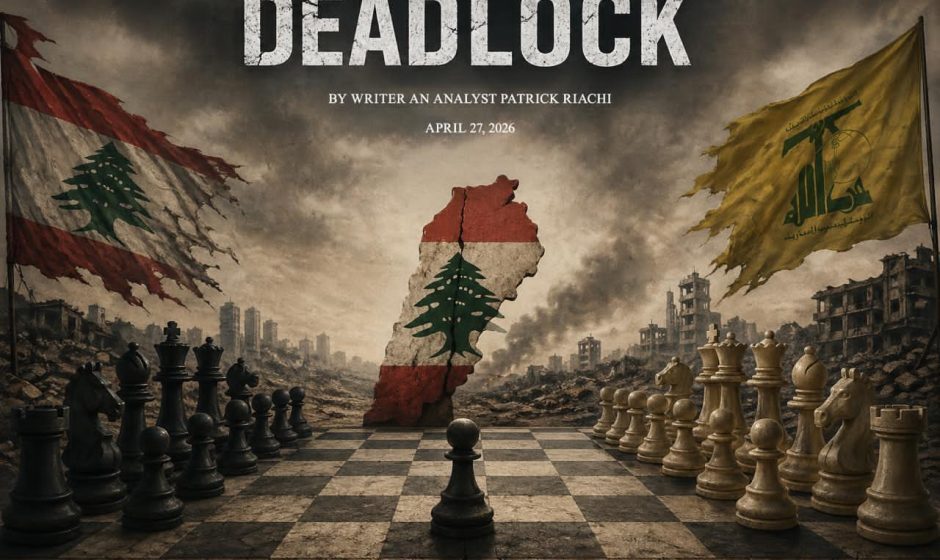

Deadlock
By writer an analyst Patrick Riachi
April 27, 2026
Lebanon wakes each morning to a reality that feels unfinished. There is talk of calm. There are strikes in the south. Homes are left behind for a night, then returned to in the morning as if nothing has settled. There is always tension even on quiet days. A ceasefire exists in words while the ground continues to shake beneath it. This is no longer a moment. It has become a condition.
Inside, the breakage expands as a state that wants sovereignty, a force that speaks in the name of resistance, and a society trying to live with both while trusting neither are all pulled in different directions at once.
Nothing here fully breaks. Nothing fully heals. The country moves forward in place, like a treadmill.
In the region, larger powers test each other without stepping too far. Iran sends signals and waits. Israel strikes and measures the response. The world watches closely, stepping in just enough to prevent collapse, stepping back before resolution becomes real.
Lebanon absorbs all of it. It is no longer only about the border. It is about a balance that no one admits and everyone maintains. Each side pushes, then pauses. Each side calculates the next step without wanting to be the one that crosses the line that cannot be undone.
This is why a full war has not begun. This is also why the tension does not end. There is another question rising in the background. It is spoken in politics, in diplomatic rooms, and sometimes in public with caution. Could a foreign army enter Lebanon? The answer is simple and uncomfortable. A large independent foreign military presence entering Lebanon by force is highly unlikely in this moment. Any such move would risk a direct regional explosion that no major power wants. The memory of past interventions still influences heavily on every calculation.
What is possible is something else. An expansion of an existing international presence such as the United Nations Interim Force in Lebanon. More troops. A wider mandate. Stronger monitoring along the border. This kind of movement can happen inaudibly, under the language of stability rather than intervention.
Even this path faces limits. No external force can impose order on a country that has not agreed on its own direction. The outside can contain. It cannot decide. So the situation holds. No war that reshapes everything. No peace that resolves anything. Only a slow accumulation of pressure.
People continue. Life does not stop. Work goes on. Conversations return to normal tones even when the situation remains uncertain. This is how societies endure when clarity disappears. The real danger is no longer escalation. The real danger is becoming used to this. Adopting the abnormal as everyday normality. When a nation adapts to instability, it stops demanding its end. It learns how to live around it, inside it, through it. That is when the deadlock becomes more absolute than politics. It becomes part of daily life.
Lebanon stands in that space today. Not collapsing, neither recovering, but suspended in repetition. What holds it is no longer stability, only exhaustion dressed as balance. It will remain there until internal political settlements are reached, banking and governance reforms take hold, structured international support is activated, and regional tensions cool enough to reduce Lebanon’s exposure to external pressure.